

Here's the truth most ads won't tell you: composite decking is low-maintenance, not no-maintenance. Skip staining and sealing, that part is real. But up here, the strong sun, big snow, and freeze-thaw still ask a little of you. Do these few simple things and your deck looks brand new for 25 years or more.
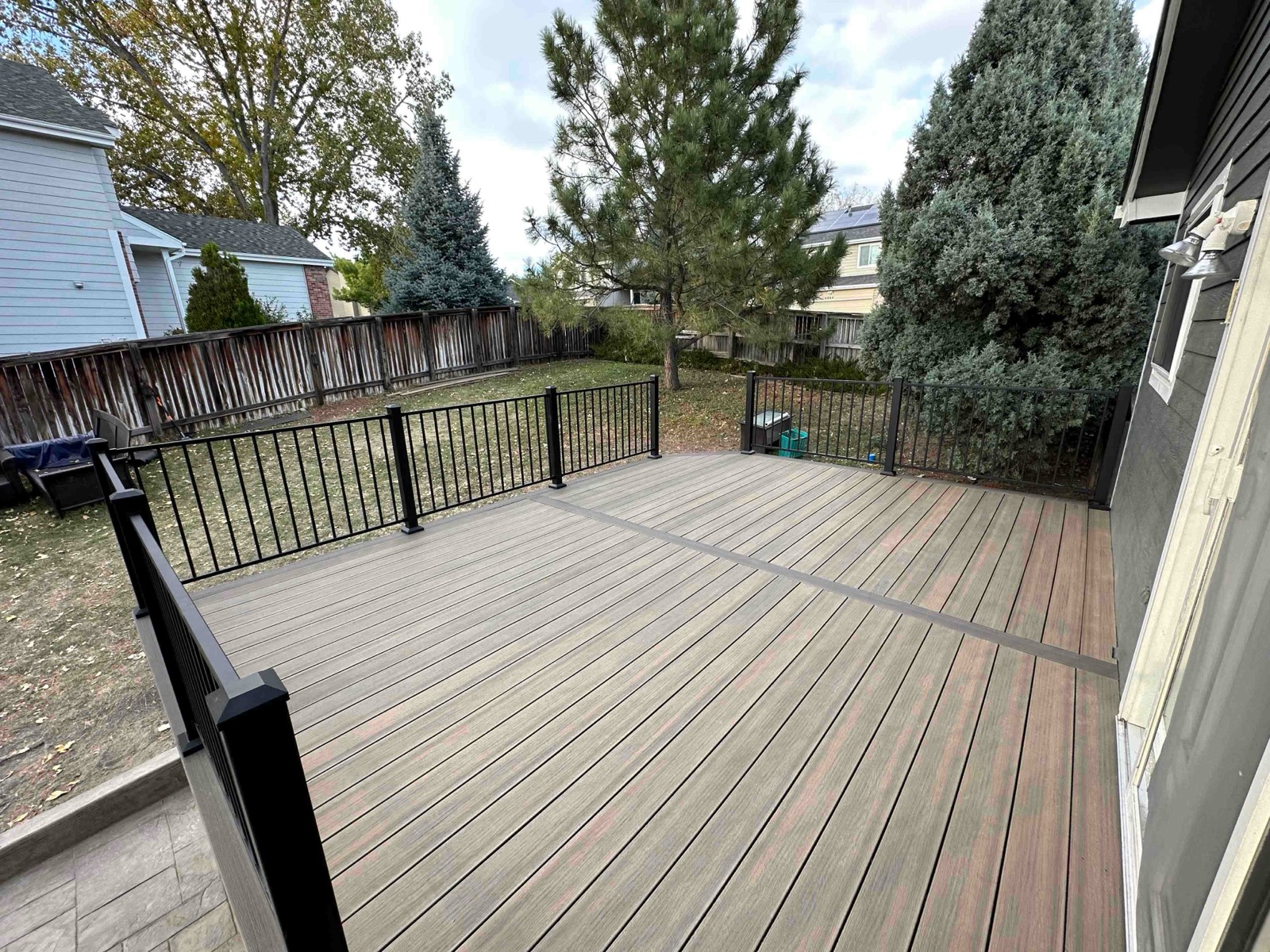
Clean it twice a year, that's most of the job
You don't sand or seal composite. You wash it. Twice a year is plenty for most Front Range yards, once in spring when the pollen and pine drop, and once in fall before the snow flies.
It's simple:
- Sweep off the leaves and dirt first.
- Mix warm water with a little dish soap or a composite deck cleaner.
- Scrub with a soft-bristle brush, never a wire or metal brush.
- Rinse with a garden hose.
If you own a pressure washer, keep it on a low setting (about 1,500 psi or less) with a wide tip, and stay back a foot. Blasting it on high can chew up the surface and void your warranty. When in doubt, a hose and a brush is the safe call.
Snow and ice: the part Colorado folks get wrong
This is where good decks get ruined. The boards themselves handle our snow just fine, it's the tools people use that cause damage. A few rules:
- Use a plastic shovel, never metal. A metal shovel or an ice chipper will gouge the boards. Even a plastic chipper can leave permanent marks.
- Shovel with the boards, not across them. Push the snow the same direction the planks run so the edge doesn't catch and ding.
- Don't scrape down to bare board. Leave a thin layer of snow on top and let it melt. You're clearing a path, not stripping it clean.
For ice, a calcium chloride or plain rock-salt ice melt is safe on composite, with one catch: no dyed or colored products. The dye in the blue and green pellets can stain the boards. Skip sand, too; it's gritty and scratches. After the ice melts, sweep or rinse the leftover residue so it doesn't sit there for weeks.
Not sure your current deck is capped composite? We can take a look and tell you what you've got, and what it'll take to keep it looking sharp. It's part of any free estimate.
Get a free deck estimateThe altitude sun is no joke, here's the good news
At Front Range elevation, roughly a mile up, the sun is far stronger than at sea level. Castle Rock and Parker get noticeably more UV than a deck in, say, Kansas. That sun fades patio furniture, cracks cheap plastic, and bleaches old wood decks gray.
Composite handles it well, but expect one thing: a slight color shift in the first few months. That's normal. Every composite mellows a touch as it settles, then holds steady for years. This is exactly why capped composite is worth it here. The "cap" is a hard outer shell baked onto the board with built-in UV blockers (titanium dioxide, if you want the technical word). It's the same idea as a good sunscreen for your deck. Uncapped or bargain boards don't have that shell, and at our altitude they show their age fast.
Scratches and the gaps you shouldn't fill
Light scratches happen, a dragged grill, a dog's nails, patio furniture. On most capped composite they buff out or blend in over a season. Felt pads under furniture legs and a mat under the grill prevent nearly all of it. For a deep gouge, many brands sell a color-match repair, or we can swap a single board.
One thing people try to "fix" that they shouldn't: the small gaps between boards. Those gaps are there on purpose. They let rain and snowmelt drain through and give the boards room to expand and contract as our temperature swings 40 degrees in a single Colorado afternoon. Don't caulk them shut. If water can't drain, it pools, freezes, and works against the deck.
Why capped composite earns its keep in Colorado
Put it together, intense UV, heavy snow, and freeze-thaw that splits lesser materials, and capped composite is built for exactly this climate. No staining, no sealing, no splinters, and a hard shell that shrugs off the sun. A quality capped deck routinely lasts 25 to 30-plus years here with nothing more than the easy routine above.
That's the whole secret: wash it twice a year, shovel it kind, and let the gaps do their job. Want a deck built right the first time with the good capped boards? See how we build decks for Front Range homes.